Currently Empty: 0,0000 €
 Audio Components
 Battery Management Systems
 Coils & Transformers
 Capacitors
 Connectors
 Crystals
 Diodes & MOSFETs
 Fuses & Protection
 LEDs
LEDs Optoelectronics
 Power Supplies
 Relays
 Resistors
 Switches
  Terminal Blocks
  Tools
Tools Wires & Cables
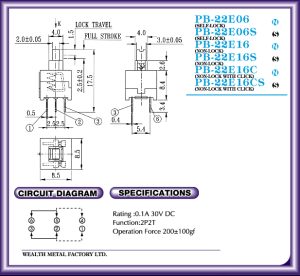
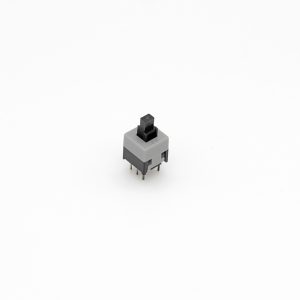
Push button switches are electromechanical devices that are used to make or break an electrical circuit when pressed. They provide a simple and reliable method of user input, allowing operators to control or interact with electronic systems. Depending on their design, push button switches can be momentary, where the contacts return to their original state after being released, or latching, where the switch remains in its new state until it is pressed again. Their durability, ease of operation, and low cost make them one of the most widely used switching components in microelectronic systems.
In microelectronics, push button switches are commonly used in embedded systems, microcontroller development boards, consumer electronics, industrial control panels, medical devices, telecommunications equipment, and automotive electronics. They serve functions such as system reset, power control, menu navigation, user input, and mode selection. In digital circuits, push buttons are frequently connected to microcontrollers or programmable logic devices, where they generate input signals that are processed by software to perform specific operations. To ensure reliable operation, these switches are often used with pull-up or pull-down resistors and software or hardware debouncing techniques to eliminate false triggering caused by mechanical contact bounce.
Push button switches are available in a wide variety of types to suit different applications. Common variations include tactile switches, illuminated push buttons, sealed waterproof switches, panel-mounted switches, and surface-mount (SMD) or through-hole PCB-mounted designs. They are also available in different sizes, actuation forces, contact ratings, and materials, allowing designers to select the most suitable switch based on factors such as available space, operating environment, electrical requirements, and expected mechanical lifetime.